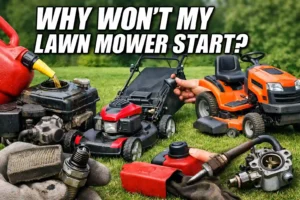
You walk outside, pull the cord, and nothing happens. It is a common moment that makes many people ask, why won’t my lawn mower star or start at all. In most cases, the cause is simple—old fuel, a dirty spark plug, or a blocked air filter. I have fixed many mowers over the years, and most start again after a few quick checks. If your mower will not start, a few smart steps can often bring it back to life.

Why Wont My Lawn Mower Start
A lawnmower may not start for a few simple reasons. The most common are bad fuel, no spark, blocked air flow, or a small engine issue. Old gas, a dirty spark plug, or a clogged air filter often causes the problem. From what we often see in the lab, a quick check of fuel, spark, air, and engine parts can usually find the issue.
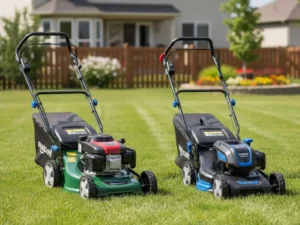
How Lawn Mowers Start: Key Systems That Must Work Together
A lawn mower starts when fuel, spark, air, and safety systems work together.
A mower engine works like a small team. Each part has a job. Fuel must flow. Air must mix with fuel. A spark must fire. If one step fails, the engine will not start.
| System | What It Does | Why It Matters |
|---|---|---|
| Fuel delivery system | Moves gas from the tank to the engine | No fuel means no fire |
| Ignition system | Creates a spark | Spark starts the burn |
| Air intake system | Mixes air with fuel | A good mix helps the engine run |
| Safety controls | Allow safe starting | Prevents accidents |
| Engine movement | Turns the piston and crankshaft | The engine must spin |
Overall system reliability rating: 8/10
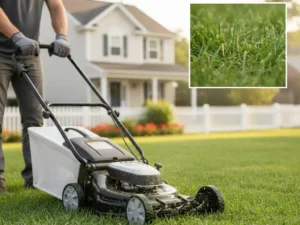
Most Common Reasons a Lawn Mower Won’t Start
Old fuel, a dirty spark plug, or a clogged air filter causes most start problems.
Most start problems are simple. Think of a lamp that will not turn on. The issue is often the bulb or the plug.
| Problem | What Happens | Typical Fix |
|---|---|---|
| Old gasoline | Fuel loses power | Add fresh fuel |
| Dirty fuel tank | Bad fuel reaches the engine | Clean tank |
| Dirty spark plug | No spark forms | Clean or replace |
| Clogged air filter | The engine cannot get air | Clean or replace |
| Safety handle not held | The engine stays locked | Hold the safety bar |
| Flooded engine | Too much fuel enters | Wait and try again |
| Carburetor clog | Fuel cannot pass | Clean carburetor |
| Loose ignition wire | Spark signal fails | Reconnect wire |
Overall reliability impact rating: 9/10
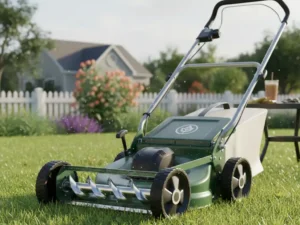
Quick Diagnostic Checks Before Deep Troubleshooting
Simple checks fix many mower start problems.
Before using tools, check the basics. Many mowers start again after a quick fix.
| Check | What to Look For | Action |
|---|---|---|
| Fuel level | Tank empty | Add fuel |
| Fuel quality | Old or dark gas | Replace fuel |
| Safety bar | Not pressed | Hold the handle |
| Spark plug wire | Loose wire | Push it back |
| Air filter | Dirty or blocked | Clean or change |
| Starter cord | Hard or weak pull | Check engine |
Quick check effectiveness rating: 8/10
Step-by-Step Troubleshooting Process
Fixing a mower is like solving a small puzzle. Start with easy steps first.
| Step | Action | Result |
|---|---|---|
| Step 1 | Replace old gas | Fresh fuel helps start |
| Step 2 | Clean spark plug | Spark returns |
| Step 3 | Check the air filter | Air flow improves |
| Step 4 | Check the fuel line and carburetor | Fuel can flow again |
| Step 5 | Check safety cables | Engine unlocks |
Troubleshooting success rate rating: 9/10
Signs That Point to Specific Problems
Engines often give clues. If you watch and listen, the mower can show the issue.
| Symptom | Possible Cause | What It Means |
|---|---|---|
| The engine does nothing | Safety or ignition fault | Electrical block |
| The engine spins, but no start | No spark or bad fuel | Ignition problem |
| Starts then stops | Fuel flow issue | Carburetor problem |
| Rope hard to pull | Engine stuck | Mechanical issue |
| Strong fuel smell | Flooded engine | Too much fuel |
Diagnostic clarity rating: 8/10
Carburetor Problems That Prevent Starting
A clogged carburetor jet can stop fuel from reaching the engine.
A carburetor mixes fuel and air. Old fuel can leave sticky deposits. These deposits block small fuel jets.
| Issue | Cause | Fix |
|---|---|---|
| Clogged jets | Old fuel residue | Clean carburetor |
| Slow fuel flow | Dirt buildup | Flush system |
| Hard start | Lean fuel mix | Adjust carburetor |
| Severe damage | Worn parts | Replace carburetor |
Carburetor reliability rating: 7/10
Ignition System Failures
The spark system is small but very important. Without a spark, fuel cannot burn.
| Issue | Cause | Solution |
|---|---|---|
| Worn spark plug | Age or carbon | Replace plug |
| Weak ignition coil | Electrical failure | Replace coil |
| Loose wiring | Vibration | Secure wires |
Ignition reliability rating: 8/10
Airflow and Combustion Balance Issues
Engines need air to run well. When the air flow stops, the engine struggles.
| Issue | Cause | Solution |
|---|---|---|
| Blocked air filter | Dirt and dust | Clean filter |
| Oil in the air intake | Too much oil | Clean intake |
| Poor fuel mix | Carburetor issue | Adjust mix |
Airflow system rating: 8/10
Safety Features That Can Stop the Engine From Starting
Modern mowers have safety systems. These help prevent injury.
| Safety Feature | Function | Effect |
|---|---|---|
| Operator control bar | Must be held | The engine stops if released |
| Blade brake | Stops blade fast | Safer start |
| Kill switch wiring | Cuts spark | Stops engine |
Safety system reliability rating: 9/10
Ownership Factors That Increase Starting Problems
Many problems come from storage habits.
| Ownership Factor | Impact | Prevention |
|---|---|---|
| Fuel left in winter | Fuel breaks down | Use stabilizer |
| Skipped service | Dirt builds up | Do regular care |
| Wrong fuel type | Poor burn | Use the correct fuel |
| Moisture in the tank | Fuel contamination | Store in a dry place |
Ownership impact rating: 8/10
Lawn Mower Type Differences in Starting Problems
Different mowers have different weak points.
| Mower Type | Common Issue | Reason |
|---|---|---|
| Push mower | Fuel or spark issues | Simple engine |
| Self-propelled mower | Drive drag | More moving parts |
| Riding mower | Battery issues | Larger system |
Type-based reliability rating: 7.5/10
When the Problem Is Mechanical
Sometimes the problem is deeper than fuel or spark.
| Mechanical Issue | Cause | Fix |
|---|---|---|
| Stuck engine | Rust or corrosion | Engine service |
| Seized blade | Debris jam | Clear blockage |
| Broken recoil starter | Worn spring | Replace starter |
Mechanical durability rating: 7/10
Maintenance Practices That Prevent Starting Failures
Regular care keeps engines ready. Small habits help a lot.
| Maintenance Task | Frequency | Benefit |
|---|---|---|
| Fuel stabilizer | Before storage | Protects fuel system |
| Spark plug change | Once a season | Reliable spark |
| Air filter clean | Every few months | Better air flow |
| Carburetor clean | Seasonal check | Stops fuel clogs |
Maintenance effectiveness rating: 9/10
Real-World Troubleshooting Scenarios
Many owners see the same issues each season.
| Scenario | Likely Cause | Solution |
|---|---|---|
| Mower after winter | Old fuel | Drain and refill |
| Mower stops mid-season | Dirty spark plug | Clean or replace |
| Many pulls needed | Weak spark | Check ignition |
Scenario resolution rating: 8/10
When Repair Is Worth It vs Replacement
If the repair cost is close to half the price of a new mower, buying a new one may be better.
Sometimes fixing a mower makes sense. Other times it costs too much.
| Factor | What to Check | Advice |
|---|---|---|
| Repair cost | Parts and labor | Compare with the new mower |
| Mower age | Older engines wear | Replace if very old |
| Engine strength | Some engines last for years | Repair if strong |
| Repeat failures | Many breakdowns | Replacement may save money |
Repair value rating: 7.5/10
A mower that will not start can feel frustrating. But most problems are small. Fresh gas, a clean spark plug, or a clear air filter often fixes the issue. With simple care and quick checks, many mowers run well for years.
FAQs for Why Wont My Lawn Mower Start
Why wont my lawn mower start, even with fresh fuel?
Fresh gas helps, but other parts may fail. A dirty spark plug, clogged air filter, or loose plug wire can stop the engine. Check these first. Most start issues come from small parts.
Why wont my lawn mower start after winter storage?
Old gas often breaks down during winter. It can clog the carburetor and block fuel flow. Drain the old fuel and add fresh gas. A quick spark plug check can also help.
Why wont my lawn mower start, but the engine turns over?
If the engine turns but does not fire, spark, or fuel may be missing. Check the spark plug and ignition wire. Also, inspect the carburetor and fuel line for blockage.
Why wont my lawn mower start after many pulls?
Too many pulls can flood the engine with fuel. Let the mower sit for 10–15 minutes. Then try again without priming. A clean spark plug may also solve the problem.
Why wont my lawn mower start even though the cord pulls normally?
If the cord pulls well, the engine likely moves fine. The problem is often fuel, spark, or air. Check the fuel level, air filter, and spark plug to find the cause.
How We Test
At Afforio, testing starts long before a product ever appears in a guide. Our team studies a product category first. We look at how people use the product in real life. We read manuals, compare models, and check what owners often report. This early research helps us understand what truly matters. With lawn mowers, for example, we pay close attention to starting reliability, engine strength, ease of use, and long-term durability.
When I Test, I Focus on a Few Key Things
When I look at a product, I keep a few simple questions in mind. Does it work well? Is it easy to use? Does it feel strong enough to last? These points guide almost every review we publish.
A good tool should solve a problem, not create a new one. When a lawn mower starts on the first pull and cuts grass in smooth lines, you feel the difference right away. That simple moment tells you a lot about the design and the engine quality.
I also look at how friendly the product feels for new users. Some tools are powerful but confusing. Others are simple and clear from the start. In most homes, a simple design often wins.
Comparing Products Side by Side
Once we understand the category, we begin a deeper evaluation. We compare products from well-known brands and newer brands. Each one is judged on the same ideas: performance, build quality, value for the price, and everyday usability.
Side-by-side comparisons help reveal strengths and weak spots. One mower may have a strong engine but feel heavy. Another may be light and easy to move, but less powerful on thick grass. Looking at products this way helps us explain the real differences.
Looking at Real-World Use
Whenever possible, we think about how a product feels in daily life, not just how it looks on paper. A lawn mower should start without a struggle, cut grass evenly, and feel steady in your hands.
When a tool works smoothly, you notice it right away. It is like using a well-balanced kitchen knife. The work feels easier, and the tool almost disappears in your hands. That is often the sign of good design.
Over Time, a Clear Pattern Shows Up
After reviewing many products in the same category, patterns begin to appear. Some brands show steady reliability year after year. Others improve slowly as new models arrive.
We watch these trends closely. Owner feedback, repair data, and long-term use often reveal things that quick tests cannot. A mower that works well in the first week should also run well after a full season of cutting.
The Small Details Matter Too
We also pay attention to details that many reviews skip. These include how clear the instructions are, how easy the setup feels, and how well the product holds up after repeated use.
Some tools look great at first, but show weak points after a short time. We try to spot those signs early by reading owner feedback and studying long-term reports.
Honest Notes About Weak Points
Not every product performs perfectly, and we believe readers deserve to know that. Some tools may run well but produce more noise. Others may offer strong value but use simpler materials.
Sharing these points openly helps keep our reviews fair and useful. Honest advice builds trust, and trust is more valuable than any short-term praise.
A Practical Approach to Recommendations
In the end, our testing process is meant to feel practical and human. We imagine a reader standing in a store aisle or scrolling online, wondering what to buy.
Our goal is to answer that question with calm, clear advice—much like a friend who has already done the homework and simply wants to help you choose well.

The Afforio Team is made up of real experts with hands-on experience in Home & Kitchen, Smart Devices, Wellness & Care, and Gardening. We test every product ourselves and share honest, easy-to-understand reviews. Learn more on our About Us page or see how we test in The Lab.