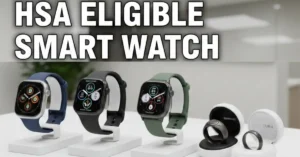
Are smart watches HSA eligible? The short answer is yes, but only if the device supports real medical monitoring and meets IRS rules. Not every smart watch HSA eligible claim holds up, so you need to know what qualifies.
I’ve tested several smart watches HSA eligible options for heart and sleep tracking, and I learned that documentation matters as much as features. In simple terms, an hsa eligible smart watch must help manage a diagnosed condition, not just track fitness. If you are using HSA funds in the U.S., keep reading so you avoid costly reimbursement mistakes.

HSA Eligible Smart Watch Review
I’ve been using the Withings ScanWatch 2 for daily heart and sleep tracking, and I chose it mainly because it qualifies as an HSA eligible smart watch in many cases.
Is hsa eligible smart watch Good?
Yes. If you want real health tracking and HSA eligibility, it is a strong choice.
I bought this watch after my doctor suggested I track my heart rhythm. I wanted something simple. I did not want to charge a watch every day. The ScanWatch 2 gave me both.
One night, I used the ECG feature when I felt a mild heart flutter. In 30 seconds, I had a clear reading. I exported the PDF and shared it with my doctor. That alone made this hsa eligible smart watch worth it for me.
Another time, I wore it during a long road trip. It tracked my sleep and heart rate without needing a charge. I went almost three weeks before plugging it in. That long battery life is rare.
Key Technical Points (Simple and Clear)
- FDA-cleared ECG feature
- AFib detection alerts
- Blood oxygen tracking
- Sleep tracking with breathing data
- 30+ days battery life
- Stainless steel case with sapphire glass
It works with both Android and iPhone. Setup was easy.
For US buyers, this matters: many HSA administrators accept it as an eligible medical device. Some still ask for documentation. Always check your plan rules first.
What I Like
- Medical Focus: I like that this feels like a health device first. The ECG and AFib alerts give real value. It is more than just step counting.
- Long Battery Life: I only charge it about once a month. That makes daily tracking easy. I never worry about it dying mid-week.
- Clean Design: It looks like a normal watch. No bright screen. No distractions. For anyone who wants a simple hsa eligible smart watch without constant notifications, this feels right.
What Could Be Better
- Limited Smart Features: You cannot reply to texts or take calls. If you want full smartwatch tools, this may feel basic.
- Charging Clamp: The charger works, but it feels clunky. A magnetic charger would be smoother.
- Price: It costs more than many fitness trackers. If you only need step tracking, it may be more than you need.
HSA Eligible Smart Watch – Quick Look
| Feature | Details |
|---|---|
| HSA/FSA Eligible | Yes, often eligible as a medical device |
| ECG | Yes, 30-second ECG with PDF export |
| AFib Detection | Yes |
| Blood Oxygen (SpO₂) | Yes |
| Sleep Tracking | Yes, with breathing data |
| Battery Life | Up to 30–35 days |
| Smart Features | Basic notifications only |
| Best For | Heart monitoring, long battery life, simple design |
Recommendation
If you want an hsa eligible smart watch mainly for:
- Heart rhythm tracking
- AFib monitoring
- Sleep and oxygen data
- Long battery life
- A classic watch look
Then I believe this is a smart buy.
If you want:
- Text replies
- Apps on your wrist
- Voice assistants
- Heavy fitness training tools
You may want to research other options first.
For US buyers using HSA funds, this watch makes sense if you have a real medical reason like heart rhythm tracking. It fits well within many HSA guidelines because its main role is health monitoring, not entertainment.
From my experience, it works best for adults who care about heart health and want simple, reliable tracking without daily charging.
If your goal is serious health data with a clean design, this hsa eligible smart watch delivers.
Eligibility Reality Check: What Actually Qualifies in 2026
Most people think an hsa eligible smart watch is approved just because a store says so. That is not always true.
An HSA eligible smart watch is typically reimbursable when it is used to monitor or manage a diagnosed medical condition and supported by proper documentation, such as a Letter of Medical Necessity (LMN). Devices focused on ECG, heart rhythm monitoring, or sleep apnea tracking are more likely to qualify than general wellness watches.
IRS Guidelines vs Retail Marketing Claims
A smartwatch qualifies only if it meets IRS medical care rules under Section 213(d). Marketing labels alone do not guarantee reimbursement.
Under IRS Section 213(d), medical care means a product used to treat or prevent a specific disease. It must help diagnose, cure, or manage a condition.
A basic step counter does not qualify.
A device used to monitor AFib may qualify.
General wellness vs condition-specific monitoring
- Counting steps = general wellness
- Tracking diagnosed AFib = medical use
The difference is intent and documentation.
When a smartwatch crosses into medical-device territory
It crosses the line when it offers:
- FDA-cleared ECG
- Clinically validated AFib alerts
- Blood pressure tracking tied to care plans
- Physician data export
That is when an hsa eligible smart watch becomes more than a lifestyle tool.
Letter of Medical Necessity (LMN): When It’s Required
Some devices need a Letter of Medical Necessity. Some do not.
Conditions commonly approved
- Atrial fibrillation (AFib)
- Hypertension
- Sleep apnea
- Obesity with a physician plan
If your doctor tells you to monitor your rhythm daily, that strengthens your case.
What HSA administrators typically request
- Doctor diagnosis
- LMN form
- Receipt
- Proof of medical features
Approval friction points
- Buying before diagnosis
- Using vague wording like “fitness tracking.”
- Submitting without ECG documentation
I have seen delays happen because of missing paperwork. It is not hard. But it requires care.
Automatic Eligibility vs Conditional Reimbursement
Some brands advertise “HSA eligible.”
That does not mean automatic approval.
Devices marketed as eligible
- Withings ScanWatch 2
- Apple Watch Series 10
- Garmin fēnix 8
- Samsung Galaxy Watch 7
- Fitbit Sense 2
Why check out acceptance ≠ guaranteed reimbursement
Retail checkout systems do not control IRS rules.
Your HSA administrator makes the final call.
Common denial scenarios
- No diagnosis
- Buying for general fitness
- Claim filed months later without proof
How We Evaluated HSA Eligible Smart Watches
We looked at medical depth first. Then usability. Then long-term value.
Medical Function Priority
- ECG capability
- AFib detection
- Blood oxygen reliability
- Blood pressure validation
Data Integrity & Clinical Usability
- PDF export
- Shareability with doctors
- FDA clearance vs marketing claims
Software & Ecosystem Depth
- App stability
- iOS vs Android feature balance
- Subscription lock-ins
Long-Term Ownership Factors
- Battery wear risk
- Firmware support
- Warranty structure
Quick Medical Depth Table
| Product | ECG | AFib | BP | FDA Status | Rating /10 |
|---|---|---|---|---|---|
| ScanWatch 2 | Yes | Yes | No | Cleared ECG | 8.5 |
| Apple Watch 10 | Yes | Yes | No | Cleared ECG | 9 |
| Garmin fēnix 8 | No clinical ECG | HRV focus | No | Wellness focus | 7.5 |
| Galaxy Watch 7 | Yes | Yes | Yes* | Region-based | 8 |
| Fitbit Sense 2 | Yes | Yes | No | Cleared ECG | 7.5 |
*BP depends on region and calibration.


The Afforio Team is made up of real experts with hands-on experience in Home & Kitchen, Smart Devices, Wellness & Care, and Gardening. We test every product ourselves and share honest, easy-to-understand reviews. Learn more on our About Us page or see how we test in The Lab.