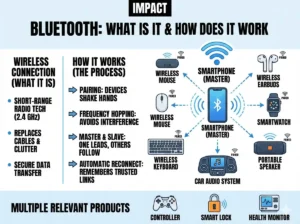
Have you ever wondered how your phone magically plays music in your car without a single wire? To understand Bluetooth what is it how does it work, think of it as a tiny, invisible radio that lets your gadgets talk to each other over short distances. In my years of testing tech here in the States, I have found that a Bluetooth connect is the most reliable way to sync your life, even if it occasionally hiccups in crowded malls.
It is a simple tool designed to make your daily routine seamless and cord-free. Just tap a button on your screen to see how Bluetooth what is it how does it work on a phone to simplify your world.

What Is Bluetooth?
Most of us use Bluetooth every single day. We connect our phones to our cars, pop in wireless earbuds, or type on a wireless keyboard. But rarely do we stop to ask what is actually happening.
Bluetooth is a short-range wireless technology that uses radio waves to connect devices like phones and speakers without cables.
Simple Definition of Bluetooth
Bluetooth is a global standard for wireless communication. It replaces cables. It lets electronic devices talk to each other over short distances. Once two devices know each other, they connect automatically.
- Wireless technology that removes clutter.
- Short-range communication for personal space.
- Data transfer that is secure and easy.
What Bluetooth Is Used For
We use it for many things. It handles audio streaming for music and calls. It connects input devices like mice and keyboards. It even helps share files between nearby phones.
- Audio streaming (headphones, speakers).
- Device input (keyboards, mice).
- Data sharing (AirDrop, file transfer).
Real-life context:
Think about a normal morning. You put on your wireless earbuds to listen to a podcast. Your phone stays on the desk. You walk to the kitchen for coffee. The music keeps playing. That is Bluetooth at work.
Why Bluetooth Exists
Bluetooth was made to fix a mess of cables. It makes portable devices easy to use. It is not built for raw speed like Wi-Fi. It is built for convenience.
Bluetooth connects devices near you without wires, making life simpler and desks cleaner.
| Feature | Details |
| Main Goal | Replace data cables |
| Key Benefit | Wireless freedom |
| Speed | Moderate (good for audio) |
Rating: 10/10 (Essential for modern life)
A Brief History of Bluetooth
Bluetooth has quietly become a part of everything we own. It started small but grew fast.
When and Why Bluetooth Was Created
Engineers developed it in the late 1990s. They wanted to solve the problem of incompatible cables. They needed a way for different devices to speak the same language over short distances.
- Developed in the late 1990s.
- Solved cable mess issues.
- Aimed at personal area networks.
Who Maintains the Bluetooth Standard
No single company owns Bluetooth. It is managed by the Bluetooth Special Interest Group (SIG). They make sure a headset from one brand works with a phone from another brand.
- Managed by Bluetooth SIG.
- Ensures global compatibility.
- Oversees updates and certifications.
Bluetooth is a global standard managed by the SIG to ensure all your devices work together smoothly.
| Feature | Details |
| Origin | Late 1990s |
| Governance | Bluetooth SIG |
| Focus | Compatibility |
Rating: 9/10 (Strong governance keeps it reliable)
How Bluetooth Works
You do not need an engineering degree to understand this. Here are the basics that actually matter.
Bluetooth works by sending data over short-range radio waves in the 2.4 GHz band, hopping frequencies to avoid interference.
Short-Range Wireless Communication
Bluetooth works within a limited distance. It is designed for your “personal bubble.” It is not for long-range networking like a cell tower. It creates a small network just for you.
- Works within a limited distance (usually 30 feet).
- Designed for nearby devices.
Radio Waves and the 2.4 GHz Band
It uses the same frequency range as many household items. It shares space with Wi-Fi and baby monitors. To fix this, it uses Frequency Hopping. It jumps between channels very fast.
- Uses the 2.4 GHz ISM band.
- Automatically avoids interference.
Sensory detail:
Ever had audio cut out in a crowded café? That is shared airwaves at work. Your headphones are fighting for space, and usually, they win by hopping to a new, clear channel.
Device Pairing Explained
Security is key. You must introduce devices first. This is called Pairing. It is a one-time setup. Once they shake hands, they trust each other.
- One-time setup creates a bond.
- Creates a secure link key.
- Devices remember this key forever.
How Devices Communicate
One device leads, and the other follows. In a Piconet, your phone is usually the leader. Your watch is the follower. The leader sends data. The follower listens and responds.
- One device initiates (Master).
- The other responds (Slave).
- Data flows in small packets.
Bluetooth uses smart radio waves to link devices securely, hopping frequencies to keep the connection clear.
| Feature | Details |
| Method | Radio Waves |
| Frequency | 2.4 GHz |
| Security | Encrypted Pairing |
Rating: 9/10 (Smart tech that handles interference well)
Types of Bluetooth and Versions
Not all Bluetooth works the same way. It has evolved.
Classic Bluetooth
This is the older style. It is designed for continuous data. It is great for streaming music. If you have older car audio, it likely uses this.
- Designed for steady streams.
- Common for audio and voice.
- Used in car systems.
Bluetooth Low Energy (BLE)
This was a game-changer. Bluetooth Low Energy (BLE) uses very little power. It sends small bursts of data. It sleeps when not in use. This lets fitness trackers run for months on a tiny battery.
- Uses very little power.
- Ideal for wearables (Fitbit, Apple Watch).
- Designed to save battery life.
Why Newer Versions Are Better
Versions like 5.0 and up are faster. They reach further. They are more stable. If your audio rarely drops out now, thank the newer versions.
- Improved stability.
- Better power efficiency.
- Faster connections.
Newer Bluetooth versions connect faster and use less battery, making them perfect for modern smart gadgets.
| Feature | Details |
| Classic | Good for Audio |
| BLE | Good for Battery |
| V5.0+ | Best Range/Speed |
Rating: 9/10 (Constant updates keep it useful)
Common Uses of Bluetooth in Daily Life
Bluetooth hides in plain sight. It is everywhere.
Personal Devices
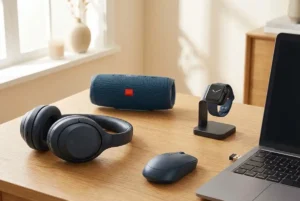
We use it for fun. Wireless headphones let us move freely. Smartwatches track our steps and send data to our phones without us looking.
- Wireless headphones and earbuds.
- Smartwatches and fitness trackers.
Work and Productivity
It clears up our desks. Wireless keyboards and mice mean fewer cords to tangle. In meetings, we use clickers to change slides.
- Wireless keyboards and mice.
- Presentations and peripherals.
Cars and Smart Homes
It keeps us safe in the car. Hands-free calling uses Bluetooth. At home, smart locks open as we walk up.
- Hands-free calling.
- Smart lights and locks.
Real-life touch:
Most people first notice Bluetooth when their car connects automatically before the engine even warms up. It just works.
From cars to keyboards, Bluetooth powers the wireless gadgets that make our daily routines smoother.
| Use Case | Example |
| Audio | AirPods, Speakers |
| Input | Mice, Keyboards |
| Auto | Car Stereo |
Rating: 10/10 (Versatile and everywhere)
Advantages of Bluetooth
Why is it still everywhere? Because it solves problems simply.
- No cables: It cleans up space.
- Low power consumption: It saves your battery.
- Simple setup: Press a button to pair.
- Works across brands: It is universal.
Actionable advice:
Use Bluetooth for short, frequent connections—like earbuds or a mouse—not for sending huge video files.
Bluetooth is the king of convenience, offering easy, low-power connections that work with almost everything.
| Pro | Benefit |
| Wireless | No mess |
| Universal | Works on all phones |
| Energy | Saves battery |
Rating: 9/10 (Hard to beat for ease of use)
Limitations and Disadvantages
It is not perfect. A fair look helps you use it better.
- Limited range: You cannot walk far away.
- Slower than Wi-Fi: It is not for big downloads.
- Interference: It can struggle in busy areas.
- Not for large files: It takes too long.
Natural tone:
Great for earbuds, not so great for sending a full 4K movie to your friend. Use Wi-Fi for that.
While convenient, Bluetooth is slower than Wi-Fi and has a shorter range, so it is best for small tasks.
| Con | Details |
| Range | Short (~30 ft) |
| Speed | Slow for files |
| Stability | Can drop out |
Rating: 7/10 (Good for its purpose, bad for big data)
Bluetooth Security and Safety Basics
Simple habits make a big difference in safety.
Pairing and Trusted Devices
Only pair with things you own. Do not accept random requests. If you sell a car or phone, remove the old devices from the list.
- Pair only with known devices.
- Remove old connections.
When to Turn Bluetooth Off
In very crowded public places, it is smart to turn it off if you are not using it. This saves a little battery and stops strangers from trying to connect.
- In public places.
- When not using it.
- To save battery.
Keep Bluetooth safe by only pairing with your own devices and turning it off when you don’t need it.
| Tip | Action |
| Pairing | Be picky |
| Public | Turn off |
| Old items | Delete/Forget |
Rating: 8/10 (Safe if used correctly)
Bluetooth vs Other Connection Types
Choosing the right tool matters.
Bluetooth vs Wi-Fi
Bluetooth is for your personal space. It is low power and easy. Wi-Fi is for the internet. It is fast and covers the whole house.
- Bluetooth: Short-range, low power.
- Wi-Fi: High-speed internet access.
Bluetooth vs Wired Connections
Wires are reliable. They never drop out. But wires are messy. Bluetooth gives you freedom. It depends on if you want to move around or stay put.
- Wireless: Convenience.
- Wired: Maximum reliability.
Bluetooth is for close-range ease, while Wi-Fi is for speed and internet, and wires are for 100% stability.
| Type | Best For |
| Bluetooth | Audio, Wearables |
| Wi-Fi | Internet, Video |
| Wired | Zero Latency |
Rating: 9/10 (Fills a unique niche perfectly)
Why Bluetooth Still Matters Today
Bluetooth is a quiet technology. It keeps adapting. It supports our modern mobile lifestyles. It powers the wearables we love. It continues evolving without disrupting us. It is the invisible glue of our digital world.
FAQs for bluetooth what is it how does it work
What is Bluetooth technology simply?
It is a wire-free link for you. It joins phones and parts nearby. It uses radio waves to talk. It helps replace old cords. It works with ease and speed.
How does Bluetooth work to connect?
It sends data through the air. It swaps channels really fast. This keeps the link very strong. It acts like a small radio. It joins two things close by.
Does Bluetooth use up my data plan?
No, it does not use the web. It makes its own direct link. It joins things right near you. It works with no Wi-Fi at all. It is free for you to use.
Is it safe to leave Bluetooth on?
It is safe for most daily use. Turn it off in big crowds. This stops unwanted links to you. It also helps save your power. Your charge will last much longer.
Why won’t my devices pair up?
Your device may be too far off. Or it is not ready to pair. Turn it off and then on. Check if it has full power. Keep both things close to connect.

The Afforio Team is made up of real experts with hands-on experience in Home & Kitchen, Smart Devices, Wellness & Care, and Gardening. We test every product ourselves and share honest, easy-to-understand reviews. Learn more on our About Us page or see how we test in The Lab.