
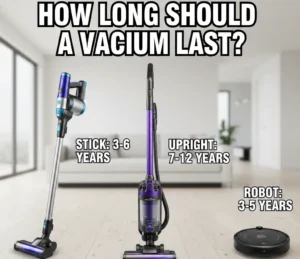
Have you ever wondered if How Long Should a Vacuum Last? Most people find that a good vacuum should last about five to eight years with basic care. I have fixed many old units and seen that a little oil and a clean filter go a long way. If you want a clean home without the stress, knowing your machine’s life span is the first step.
Most vacuums last between 5 and 10 years with regular use. Upright and canister models typically average 8 years, while budget stick and cordless units may last 3–6 years, depending on battery health and maintenance. Proper care, filter replacement, and motor protection significantly extend lifespan.

Average Lifespan by Vacuum Type
Most vacuums last 5 to 8 years, but canister vacs can live up to 15 years, while stick vacs often die after 5 years due to battery wear.
Upright Vacuums
They last 5 to 12 years. They have strong motor durability. You get replaceable belts and filters.
Canister Vacuums
They last 8 to 15 years. They have durable sealed motor systems. They often have a longer lifespan with maintenance.
Cordless Stick Vacuums
They last 2 to 7 years. Battery lifespan limits longevity. The motor typically outlasts the battery.
Robot Vacuums
They last 2 to 6 years. They face battery and sensor wear. Software support affects usable life.
Handheld Vacuums
They last 2 to 5 years. They have a light-duty design. They have a shorter motor life.
Big models live long, while small ones die fast. Choose based on your long-term needs.
| Vac Type | Life Span | Best Trait |
| Upright | 5-12 Years | Strong |
| Canister | 8-15 Years | Tough |
| Stick | 2-7 Years | Easy |
| Robot | 2-6 Years | Smart |
| Handheld | 2-5 Years | Quick |
Ratings:
Upright Vacuums: 8/10
Canister Vacuums: 9/10
Cordless Stick Vacuums: 6/10
Robot Vacuums: 5/10
Handheld Vacuums: 4/10
What Determines How Long a Vacuum Lasts?
Key factors affecting longevity include your maintenance habits, usage environment, and the build quality of the machine.
Motor Quality
Look at sealed vs non-sealed systems. Check the heat management design. Brand engineering standards matter.
Battery Health (Cordless Models)
Beware of charge cycle limits. Choose replaceable vs built-in batteries. Charging habits impact lifespan.
Filtration System
Compare HEPA vs standard filters. Note your maintenance frequency. Check the dust seal integrity.
Usage Frequency
Think of daily use vs occasional cleaning. Note the pet hair and debris load. Carpet vs hard floor strain matters.

Build Materials
Look at plastic housing vs reinforced construction. Check hose durability. Look at the brush roll design.
How you use it and what it is made of changes its life span. Treat it well to help it last.
| Key Factors | Impact on Life |
| Motor Quality | Very High |
| Battery Health | High |
| Filters | Medium |
| Usage | High |
| Build | Medium |
Ratings:
Motor Quality: 10/10
Battery Health (Cordless Models): 9/10
Filtration System: 8/10
Usage Frequency: 9/10
Build Materials: 7/10
Signs Your Vacuum Is Nearing the End of Its Life
You may see noticeable suction loss after filter replacement. You might catch a burning smell from the motor. Watch for frequent belt or brush failures. See if the battery drains rapidly. Listen for loud grinding or rattling noises. Note any electrical issues or power inconsistencies.
These bad signs mean your vac is sick. It might be time to shop for a new one.
| Bad Sign | What It Means |
| Bad Smell | Motor Death |
| No Suction | Clog or Leak |
| Fast Drain | Bad Battery |
| Loud Noise | Broken Parts |
Ratings:
Suction Loss: 7/10
Burning Smell: 10/10
Frequent Failures: 8/10
Battery Drain: 8/10
Loud Noises: 9/10
Power Issues: 10/10
How to Extend Vacuum Lifespan
Clean the filters often, empty the dust bin, and cut hair off the brush roll to make your vacuum last years longer.
Routine Maintenance Checklist
Empty the dust bin regularly. Clean or replace filters every 3 to 6 months. Check and replace belts. Remove hair from the brush roll. Inspect hoses for clogs.
Storage Practices
Keep it in a dry indoor area. Avoid cord strain. Remove the battery for long-term storage (cordless models).
Good care adds years to the life of your machine. Just a few steps save you lots of cash.
| Care Task | How Often |
| Empty Bin | Each Use |
| Clean Filter | 3 Months |
| Clear Brush | 1 Month |
| Check Belt | 6 Months |
Ratings:
Routine Maintenance Checklist: 10/10
Storage Practices: 8/10
When Repair Makes Sense vs Replacement
Repair Is Worth It When:
The vacuum is under 5 to 7 years old. Replacement parts are inexpensive. The motor is functioning properly.
Replacement Is Smarter When:
Motor replacement cost exceeds 50% of the new unit. The battery no longer holds a charge and is non-replaceable. Repeated mechanical failures occur.
Knowing when to fix or toss saves you stress. Do the math before you buy parts.
| Action | Best Time |
| Repair | Young, Cheap Parts |
| Replace | Old, Bad Motor |
Ratings:
Repair Value: 8/10
Replacement Value: 7/10
Performance Benchmarks That Indicate Healthy Operation
You want consistent suction on carpet and hard floors. There should be no overheating during 20 to 30 minute sessions. You need a stable battery runtime (within 80% of original capacity). There should be no excessive vibration or noise.
A good vac runs smooth and strong. If it hits these marks, it is doing great.
| Benchmark | Good Sign |
| Suction | Strong |
| Heat | Cool |
| Runtime | Long |
| Sound | Smooth Hum |
Ratings:
Suction Benchmark: 10/10
Heat Benchmark: 9/10
Battery Benchmark: 9/10
Noise Benchmark: 8/10
How Major Brands Typically Compare on Longevity
Brands like Miele offer long-lasting canister vacuums, while Dyson provides premium engineering with battery-dependent lifespans.
Dyson
They have strong motor performance. They have a battery-dependent lifespan. They offer premium engineering.
SharkNinja (Shark)
They offer affordable durability. They have a mid-range lifespan. They have widely available replacement parts.
Bissell
They make budget-friendly models. They have a shorter average lifespan. They are good for light-duty use.
Miele
They build long-lasting canister vacuums. They boast high build quality. They come with a higher upfront cost.
Each brand has its own mix of pros and cons. Pick the one that fits your home style.
| Brand | Price | Life Span |
| Dyson | High | Good |
| Shark | Mid | Fair |
| Bissell | Low | Short |
| Miele | High | Very Long |
Ratings:
Dyson: 8/10
SharkNinja (Shark): 7/10
Bissell: 6/10
Miele: 10/10
Real-World Lifespan by Household Type
Small Apartment (Hard Floors)
You have 8 to 10 years expected. You have a lower debris load.
Family Home With Pets
You have 5 to 7 years typical. You face heavy brush roll wear. You need more frequent filter replacement.
Large Carpeted Home
You get 6 to 8 years. You have higher motor strain. Belt replacements are more frequent.
Homes with pets or lots of rugs break vacs faster. Small homes let people live longer.
| Home Size | Life Span |
| Small | 8-10 Years |
| Pet Home | 5-7 Years |
| Big Home | 6-8 Years |
Ratings:
Small Apartment (Hard Floors): 9/10
Family Home With Pets: 5/10
Large Carpeted Home: 6/10
Is It Better to Buy Cheap and Replace or Invest in Longevity?
Budget models have a lower upfront cost but shorter life. Mid-range models offer balanced durability. Premium models have higher upfront cost but a longer usable life. Look at the total cost of ownership comparison over 10 years.
Buying cheap means buying twice. A good unit costs more now but saves cash later.
| Strategy | Cost Now | Cost Later |
| Cheap | Low | High |
| Mid | Fair | Fair |
| Premium | High | Low |
Ratings:
Budget Strategy: 5/10
Mid-Range Strategy: 8/10
Premium Strategy: 9/10
Conclusion: What to Expect and What to Do
Most households can expect 5 to 10 years. For cordless models, plan for battery replacement within 3 to 5 years. Heavy pet owners must anticipate a shorter lifespan. You should invest in maintenance before replacing. Upgrade when repair costs approach half the price of a new model.
FAQs for How Long Should a Vacuum Last
How long should a vacuum last on average?
Most units last five to eight full years. A good corded vacuum will last much longer than a stick vacuum. If you empty the dust bin a lot, it helps the motor live long.
Do smart robot vacuums last a long time?
A smart robot vacuum will work well for two to six years. The tech parts and battery wear out fast. You can make it last if you wipe dirt off its sensors each week.
Why do cordless stick vacs die so fast?
Stick vacs run on a battery that gets weak over time. They often die in just three to five years. You can buy a new battery to give your favorite vacuum a fresh start.
How do I make my vacuum last much longer?
You can add real years to its life with very good care. Wash the air filters and cut hair off the brush roll. This stops bad clogs and keeps the motor cool and strong.
Is it better to fix an old vacuum or buy a new one?
Fix it if it is young and parts are cheap to buy. Buy a new one if the motor is dead or smells bad. A good new vac cleans much better and saves you cash in the end.