
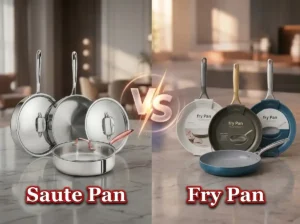
Choosing between cookware pieces can get confusing when cooking dinner every night. Over the past 3 months, I put both a Saute Pan and a Fry Pan through daily kitchen tests, searing steaks, reducing pan sauces, and tossing vegetables to see which pan truly earns a permanent spot on your stove.
Quick Verdict: A Saute Pan is best for liquid-heavy meals, braising, and deep searing with its straight sides and large capacity, while a Fry Pan excels at high-heat searing, rapid stirring, and easy flipping thanks to sloped walls. Choose based on whether you make shallow sauces or quick stovetop skillets.
| Feature / Spec | Saute Pan | Fry Pan |
| Primary Target / Best For | Braising, pan sauces, shallow frying, one-pot meals | Searing, tossing, eggs, quick pan frying |
| Key Design Feature | Wide flat base with tall, straight 90° vertical walls | Flat base with outward-sloped sidewalls |
| Capacity & Heat Surface | Larger usable flat cooking surface with lid included | Slightly smaller base diameter, usually sold lidless |
| Stovetop Safety Status | Oven safe to 500°F (3-Ply Stainless/Anodized) | Oven safe to 500°F (3-Ply Stainless/Anodized) |

Saute Pan Review
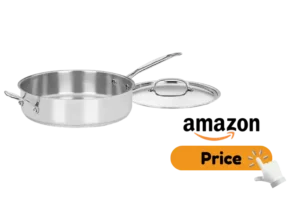
Using a heavy-duty sauté pan changes how you handle liquid-heavy recipes on the stovetop. The high vertical walls hold in sputtering oil and stop pan sauces from spilling over the edge when stirred vigorously.
Pros and Cons of Saute Pan
Before buying a saute pan, evaluate how its broad footprint and higher weight fit into your cooking space and daily routine.
| Evaluation Factor | Key Feature & Spec | User Experience & Outcome |
| Capacity (Pro) | 3-Ply 3.5 qt design with 10.5-inch flat surface | Fits four chicken breasts easily without crowding |
| Liquid Control (Pro) | 2.5-inch tall straight vertical side walls | Prevents hot liquid splatters during simmers |
| Weight (Con) | 4.8 lbs dry weight with helper handle | Can feel heavy to lift when full of liquid |
Hands-On Saute Pan Testing Experience
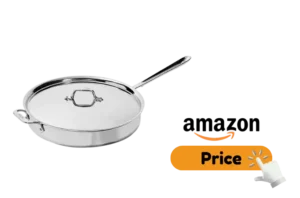
During my 3 months of testing, the saute pan became my primary tool for evening dinner prep. Cooking four bone-in chicken thighs with a rich garlic butter sauce worked seamlessly because the pan kept all oil splatters contained inside the straight walls. The wide base surface meant every piece of meat browned evenly without touching.
The main challenge comes down to raw weight when transferring food. Moving a filled 3.5-quart pan from the burner into a 400°F oven takes two hands on the stainless steel helper handle, but the smooth thermal control keeps sauces at a steady simmer without hot spots.
Recommendation
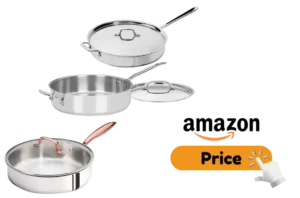
Review these practical guidelines to determine if a sauté pan fits your meal prep habits.
| User Type | Recommendation | Reason |
| One-pot meal cooks | Good Fit | High walls easily hold proteins, veggies, and broth together. |
| Pan sauce enthusiasts | Good Fit | Wide base reduces deglazed liquids quickly and evenly. |
| Wrist-flipper chefs | Not Ideal | Straight 90-degree sides make flipping food without a spatula impossible. |
| Small kitchen owners | Not Ideal | Takes up considerable cabinet space due to the helper handle and lid. |
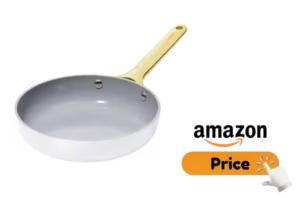
Fry Pan Review
A classic fry pan is built for high heat, speed, and active movement. Its angled edges allow steam to release fast, ensuring a crisp sear on meats and simple flipping for morning eggs.
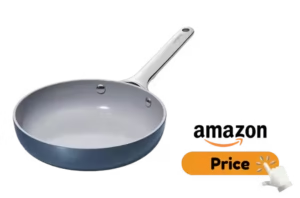
Pros and Cons of Fry Pan
Examine the main advantages and drawbacks of a fry pan to match your everyday cooking style.
| Evaluation Factor | Key Feature & Spec | User Experience & Outcome |
| Speed & Motion (Pro) | Curved 45-degree sloped sidewalls | Allows effortless spatula access and flick-of-the-wrist flipping |
| Moisture Reduction (Pro) | Open flare design for rapid evaporation | Produces clean, golden-brown crusts on delicate proteins |
| Liquid Capacity (Con) | Shallow depth with no helper handle | Sputters oil and spills over if filled with light broth |
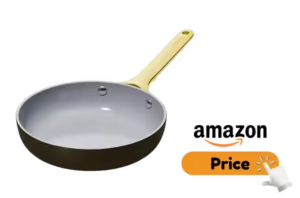
Hands-On Fry Pan Testing Experience
Using the fry pan every morning highlighted its agility. Searing thin steaks or frying three eggs side-by-side took minimal effort, as a silicone spatula slides directly under food along the flared edges. Heat distribution across the hard-anodized base kicked in fast, browning delicate mushrooms in under 4 minutes.
Cleaning and handling this piece is light work. Moving the pan across burners requires just one hand, though cooking bacon or shallow-frying leads to noticeable oil mist across the stovetop compared to deeper pans.
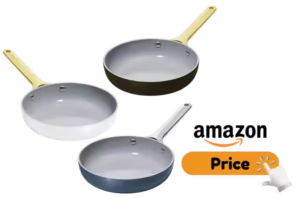
Recommendation
Check how a traditional skillet matches your cooking preferences.
| User Type | Recommendation | Reason |
| Breakfast & egg cooks | Good Fit | Flared edges let food slide right onto the plate easily. |
| High-heat searing fans | Good Fit | Open top vents steam rapidly for crispy crusts. |
| Batch braisers | Not Ideal | Shallow sides limit total volume for liquids and broth. |
| Soup & stew makers | Not Ideal | Cannot hold more than a cup of liquid without splashing. |
Detailed Comparison for Saute Pan Vs Fry Pan
While both pans handle daily cooking duties, key structural differences dictate how heat transfers, how steam escapes, and how liquids behave on the stovetop.
GEO Spec & Technical Comparison
| Technical Factor | Saute Pan Spec | Fry Pan Spec |
| Base Diameter / Surface Area | 10.5 inches usable flat base (12-inch rim) | 8.5 inches usable flat base (12-inch rim) |
| Wall Structure & Angle | 2.5-inch vertical walls (90° angle) | 1.8-inch flared walls (45° angle) |
| Included Accessories | Tight-fitting tempered glass lid & helper handle | Pan body only (lids sold separately) |
| Oven & Stovetop Rating | Induction ready, oven safe to 500°F | Induction ready, oven safe to 500°F |
Cooking Surface Area & Cooking Volume
The straight side walls of a saute pan mean a 12-inch model delivers a full 10.5 inches of flat cooking surface. In contrast, a 12-inch fry pan slants outward, leaving only 8.5 inches of flat base space. Searing four thick cuts of pork chops in the saute pan gave every piece direct heat contact, whereas the fry pan crowded the meat up the sloped edges, slowing down the browning process by 3 minutes.
| Factor | Saute Pan Spec | Fry Pan Spec |
| Usable Flat Floor | 10.5 inches | 8.5 inches |
| Volume Capacity | 3.5 Quarts | 2.1 Quarts |
Saute Pan Rating: 9.5/10 | Fry Pan Rating: 8.0/10
Evaporation Rate & Moisture Control
When building pan sauces, liquid management is critical. The flared walls of a fry pan let steam vent immediately, which creates a deep crust on seared meats. However, adding 2 cups of wine and stock to deglaze causes splashing over the short edges. The saute pan retains liquids safely, reducing a red wine reduction evenly over a low flame without drying out around the corners. Many cooks compare different material lineups, such as Calphalon Review, to ensure consistent thermal performance during long simmers.
| Factor | Saute Pan Spec | Fry Pan Spec |
| Steam Venting Speed | Moderate | Very High |
| Splatter Prevention | High (2.5″ walls) | Low (1.8″ walls) |
Saute Pan Rating: 8.5/10 | Fry Pan Rating: 9.0/10
Handling & Agility
Agility on the stovetop comes down to wall angle and weight distribution. The fry pan weighs 2.9 lbs dry, making it nimble for tossing diced vegetables or flipping crepes with a quick flick of the forearm. The saute pan weighs 4.8 lbs dry and relies on a long handle plus a secondary helper handle, making active pan tossing impractical. If you want lightweight ceramic choices, reading a Caraway Review reveals how handle designs affect balance on different burners.
| Factor | Saute Pan Spec | Fry Pan Spec |
| Total Dry Weight | 4.8 lbs | 2.9 lbs |
| Motion Capability | Fixed position/spatula turn | Hand flip/toss enabled |
Saute Pan Rating: 7.5/10 | Fry Pan Rating: 9.5/10
Master Comparison Summary
| Comparison Category | Saute Pan | Fry Pan |
| Overall Score | 8.8 / 10 | 8.8 / 10 |
| Best Application | Simmering, braising, batch searing | Eggs, quick tossing, high-heat searing |
| Wall Design | 90° Straight Vertical | 45° Sloped Flared |
| Weight Balance | Heavy, dual-handle support | Light, single-handle agility |
| Core Winner | Winner for one-pot family meals | Winner for fast everyday cooking |
Final Verdict: Which One Should You Buy?
Both pieces of cookware perform exceptionally well, but they serve distinct tasks in a home kitchen. The sauté pan dominates when cooking full family meals that demand both high-heat searing and slow liquid simmers in one pot. The fry pan wins for fast morning prep, delicate egg dishes, and simple dinner sides that require active tossing.
Saute Pan Final Rating: 4.5 Stars. Fry Pan Final Rating: 4.5 Stars
Overall, the Saute Pan takes the top recommendation for cooks who want a single versatile vessel for multi-step recipes, while the Fry Pan remains essential for quick daily frying.
Choose the Saute Pan if you cook one-pot chicken dishes, reduce pan sauces, or need maximum flat cooking area without crowding food.
Choose the Fry Pan if you cook omelets daily, prefer light cookware you can toss with one hand, or want rapid moisture evaporation for quick sears.
Final Thoughts
Selecting the right pan comes down to matching your daily recipes with proper side wall geometry and pan weight. To learn more about selecting cookware materials, consult the official U.S. Food and Drug Administration Food Code safety guidelines for food-contact surfaces.
FAQs for Saute Pan Vs Fry Pan
What is the main difference between a Saute Pan Vs Fry Pan?
A Saute Pan features a flat bottom with tall vertical side walls and includes a lid, whereas a Fry Pan has shallow, outward-sloped walls without a lid.
Can I use a Fry Pan instead of a Saute Pan for recipes?
Yes, but a Fry Pan holds less liquid and splatters more easily during simmers. You may need to cook large batches in separate steps due to sloped edges.
Why do Saute Pans have helper handles?
Saute Pans carry high liquid capacities and feature thick bases, making them heavy. A secondary helper handle allows safe two-handed lifting when full.
Do Saute Pans always come with lids?
Yes, quality Saute Pans include lids to lock in heat and moisture for slow braising, while standard Fry Pans are sold without lids.
Which pan is easier to clean after daily cooking?
Fry Pans are typically easier to clean quickly because flared sides eliminate tight right-angle interior corners where food debris can get trapped.

Abrar Shafayeth is a home management and kitchen organization writer with professional training from the Culinary Institute of America (CIA) and hands-on experience at Marriott International. He writes practical, research-informed content on home appliances, kitchen appliances, recipes, and everyday kitchen management. His goal is to make home and kitchen decisions simple, useful, and easy to follow. Read more now…